 Zenzicube
From the Mathematical Menagerie to Zenzicube
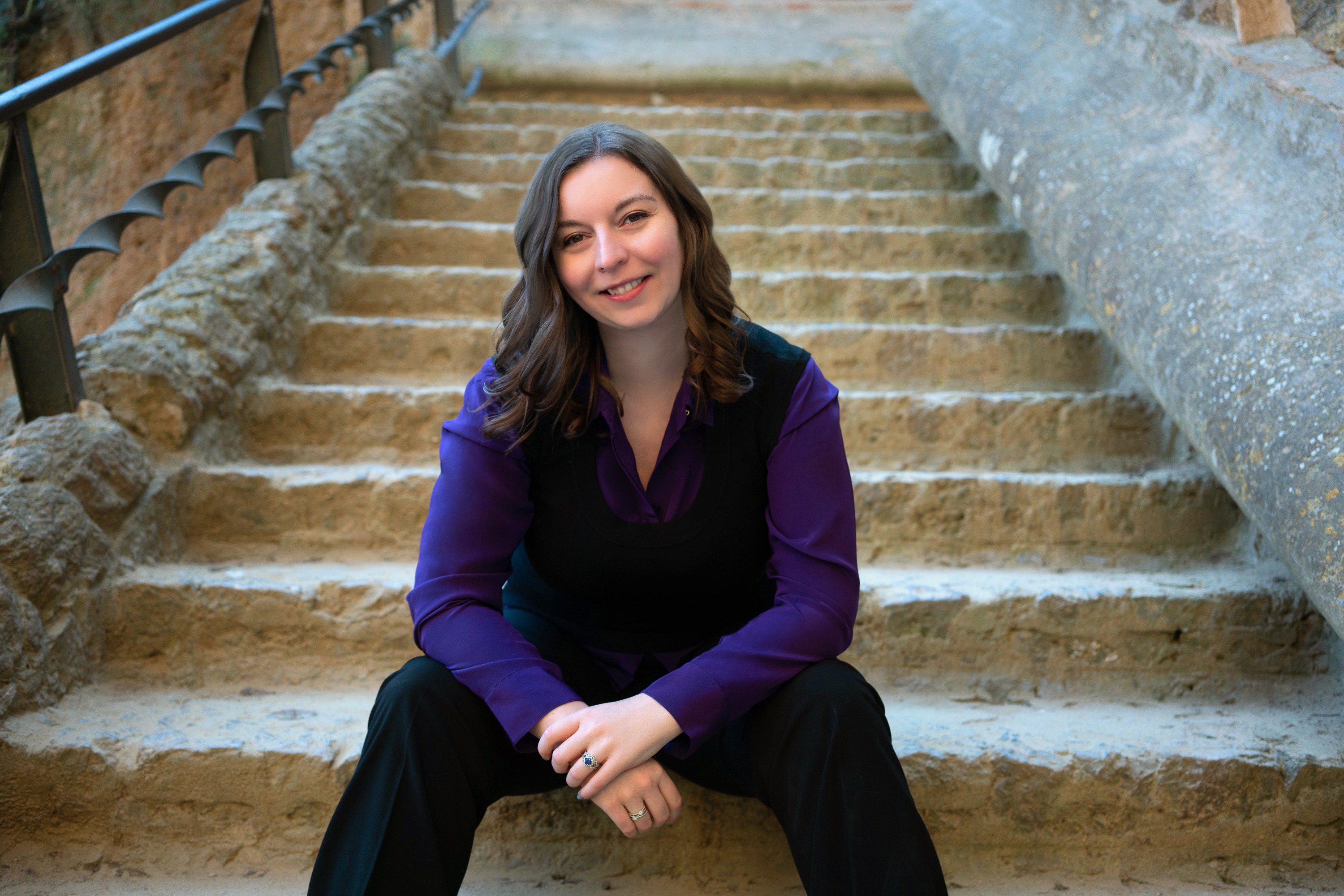
Briana Brownell is a data scientist, writer, and artist. Having spent over a decade translating complex technical and scientific concepts for businesses, boards of directors and general audiences across TIME, Discovery, PBS, and SciShow, she created Zenzicube as a calm digital sanctuary where anyone can explore procedurally generated mathematical art.
In this conversation, Briana reflects on how a hobby grew into a 200+ creature field, why traditional math education strips away joy, and what it's like to dream in mathematical symmetries.

How did the idea for Zenzicube start?
The project really morphed as I got more into it, just like all creative projects seem to. At first, I started building digital diatoms based on the drawings of Ernst Haeckel, who made thousands of scientific drawings during a three-year ocean voyage on the H.M.S. Challenger in the late 1800's. I'd find a picture of a creature in one of his books, or a photograph from a real microscope field and try to understand its symmetry well enough to describe it, then iterate to create it.
But it turned pretty quickly into a study of mathematics and symmetry rather than trying to recreate the look of real biological creatures digitally.
Then a few weeks later, I had a series of lengthy board meetings. When I was back in my hotel, I wished I had something to do that was calm and relaxing: I didn't want to scroll social media, and even TV seemed like it would be too loud and jarring.
At the time I was reading Christopher Paolini's To Sleep in a Sea of Stars. I won't give away any spoilers, but there are a lot of math-related patterns described in the book. I built maybe a dozen creatures and this session is where some of my favorite creatures came from, like the Ribbon Weaver and the Penrose Growth Rings. It was meant to be fun and meditative, letting me explore concepts and shapes I liked.
I didn't set out to build an app at all. I started just making these little mathematical creatures for myself, somewhere to spend time with the mathematical ideas I liked without needing them to be useful, the way you'd enjoy a favorite piece of music. I made myself a little field to scroll around to look for my favorites, and you could tap them to watch their animation play. That was the first iteration, I called it Mathematical Menagerie and put it as a page on my website.
What made it click as something worth pursuing?
I posted a few of the creatures on social media and someone asked if they were from a book. It made me wonder: What kind of a book would that be? A field guide for mathematical creatures? I thought that was a pretty compelling idea!
It gave me a different challenge too: now I had to think of it in terms of the whole of mathematics, what a comprehensive taxonomy might actually look like, not just the quasicrystals and regular tilings and fractals I liked. That turned out to be a great challenge because there are so many different topics within mathematics. Could I make something as simple as a parabola or a triangle compelling? And then the opposite, could I make something super complex legible enough aesthetically to draw non-math-people in?
I challenged myself to see if I could make a dozen. It turned out to be easier than I thought! There are so many breathtaking mathematical concepts waiting to be revealed through beautiful styling. I kept adding more and more ideas, scouring academic papers and math wikis and tessellation groups for ideas. Soon I was nearing a hundred. But I still hadn't cracked the parabola yet.
What was so hard to crack about the parabola?
It wasn't just the parabola, it was the whole conic sections group that gave me so, so much trouble. I knew that I wanted to start people in a place where they would see familiar shapes - things they might recognize but hopefully, be able to discover new secrets about them. But I didn't want it to look like a boring textbook or, worse, like ugly diagrams. I'd been trying every thing I could think of to get the conic sections to look beautiful but just could not get it right.
After a frustrating Sunday session, my husband and I went out to our local watering hole. My mind was primed to look for patterns and as we sat and chatted I looked at the end of the bar, which was made of a dark wood, and I realized... hey, you know what. That wood grain kind of looks like a hyperbola. And you know what else, the sun's reflection kind of looks like balls or fireworks coming from the focus of a parabola.
As soon as I got home I created the conic grain and the fireworks and pinball creatures. I love the ellipse ones, I could watch that one all day.
Why frame it as a 'Field Guide' with creatures rather than just a math app?
It's not a math app. I think it's the opposite of a math app, actually. It's whatever the opposite of homework is, or the opposite of, remember those math worksheets where you had to do calculations in class as fast as possible? No, no, this is completely different, philosophically. This is about exploration, and wonder, and contemplation.
I wanted to share my personal experience with these mathematical creatures. The more time I spent scrolling around the field I had built, before I even created the app, the more I started wondering whether the joy I felt coming across one of my favorite beautiful creatures would be fun for other people too. Even, or especially, people who don't consider themselves math people.
I think mathematics works the same way art does. You can fall for the wild branching of a fractal or the texture of a specific tiling without being able to say why, and that's not a lesser kind of understanding. After all, so much art and beauty has a mathematical component. But looking at most mathematical drawings, they're flat and boring, not captivating or awe-inspiring.
I wanted to build a sanctuary where mathematics was beautiful, and discovering these concepts is joyful and calm. For me first, and now, maybe, for you too.
Is Zenzicube for people who have math anxiety?
I hope so, actually. I want to replace that anxiety with joy. It's funny, I don't think I ever heard the term "math anxiety" growing up, but I completely get it. It's no wonder people have bad experiences with math, so much of the curriculum is just utilitarian skills-building where mathematics is completely stripped of its beauty. You have to memorize the quadratic formula to find roots and do it a hundred times without being able to feel what's happening, so you never build any intuition around it and as a result it becomes tedious or boring or both. Where's the joy? The wonder?
I want everyone to feel that joy and wonder and awe.
It's the same with so many other things: music, art, wine... In fact I think it is really quite like wine. Every sommelier can remember a moment with a special wine they enjoyed before they could describe the color or the nose or the palate in detail. We know that we don't need to explain why a wine moves us to know the moment is what matters. Being drawn to something before you know why, before you have the words, is already a real way of appreciating it.
Being drawn to something before you know why, before you have the words, is already a real way of appreciating it.
When do you remember experiencing awe or wonder as a result of a mathematical idea?
Magic squares! It just completely left me in awe. You have these squares of numbers in a grid and every row, every column, and every diagonal adds up to the same number. I learned that you can make them with a specific algorithm. I was in about grade 6 or 7, and it was like magic to me, like how is that possible, for the symmetry to be so perfect. And it was a simple idea, just adding, but I'd never learned anything like that in class, that's for sure.
The next time was a lot later: Gödel's Incompleteness Theorem, which is a theorem about proofs - so kind of meta. The tl;dr on that one is that it's a proof that there are things that are true but that can't be proven. As in, just because something is true doesn't make it provable. It's such a wild, unexpected result.
The visual aesthetic is incredibly striking. Where did that come from?
Most of the biomes I created with a palette in mind because I wanted the visuals to mean something beyond "pretty colors." Many of them are inspired from favorite music videos or art pieces.
My favorite is the Quasicrystals biome. I call the palette Prasiolite. If you take amethyst, it looks purple. But then if you heat it up to a really narrow temperature band it turns this beautiful light green - that's prasiolite. And then if you heat it up some more, you get citrine, which is like a rich golden or orange firey color. I just think it's so interesting, and most people haven't heard of prasiolite.
The other one I like is the Complex Worlds biome, the basins: I tried to get it to look like spilled ink. I wanted it to specifically have an analog feel because the actual creatures are pretty much impossible to draw. In fact you might just find something interesting and unexpected there if you look long enough...
You've worked on a wide variety of different things. How do they all fit together, and fit with what you've built with Zenzicube?
You're right, I have done a lot of very odd things in my career. But, I think that a lot of them come from the same place. I'm fascinated with the underlying patterns that govern reality. Take subatomic physics: you're looking for fundamental symmetries and interactions at the smallest scales. Is that so different from at the UN DPO, where you're modeling complex systems and data sources to help peacekeepers get clarity on chaotic, messy situations? Sure, you can't put people through a particle accelerator.... but there is definitely an underlying set of principles that lets you figure out what you can (and can't) understand within both.
For me, Zenzicube wasn't much of a departure from the things I was already working on. But I did like that it let me play a lot more, bringing the creatures to life was a real joy. Plus it lets me share my love of mathematics with other people, and I really appreciated that.
What exactly is a "Zenzicube"?
The name is from the history of mathematics, which is full of fascinating, archaic terms I wish we'd bring back, like fluents and fluxions, which are the original terms that Newton used in describing calculus. A fluxion is the derivative, and come on, which sounds more interesting?
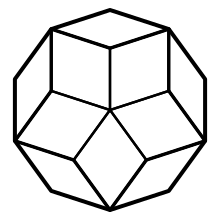
But you asked about zenzicube. In the 16th century, mathematicians used words like zenzic (for a square) and surd (for a root). A zenzicube was the term for the sixth power of a number (the square of a cube). And they kept going, too. There are zenzizenzics and zenzizenzizenzics and on and on. It's just so much fun to say, there's so much whimsy in it. I wanted to lean into that, so in the app, you'll actually find a couple zenzicube-inspired creatures! They are some of my favorites. And in fact, the logo is a projection of a 6-dimensional cube, which has an "area" of s to the sixth... a zenzicube cube.
If someone's about to open it for the first time, where should they go?
I don't think I can tell you that! I think everyone will find their own favorites and they'll be different from mine! Some people will love the polygons and others will go straight for the fractals.
I find myself going to find the regular tilings, especially the Cairo dual, a lot. Or I go hunting the Möbius strip (especially the triple twist variation). It's such a simple shape (a strip of paper with twists) but the animation follows the edge around, and you watch it travel from one side to the other across what looks like two surfaces but isn't. I find it completely mesmerizing.
Julia Metamorph is a favorite too, the Strange Attractor and the Lorenz Wings.
But so far as I've seen, everyone that wanders the field has a different favorite, a different biome that draws them in the most. You probably won't be able to find all the biomes on your first expedition, you'll have to start a few expenditions to find them all.
What's been the best thing about working on Zenzicube?
Math dreams.
Math dreams?
Yes. Math dreams. I used to have them all the time when I was in undergrad, when I was studying. A little bit in grad school, too. But basically they are these dreams that are completely conceptual, they are like a feeling and maybe a little bit of a visual but more like a pull of intuition about the truth about something abstract, like the feeling of a certain kind of symmetry. Now that I have spent so much time building and contemplating the creatures in the app, I've been having them again, and they make me wake up with such a feeling of calm and awe that really sets the tone for the whole day.
Everyone who wanders the field finds a different favorite. Go and find yours.